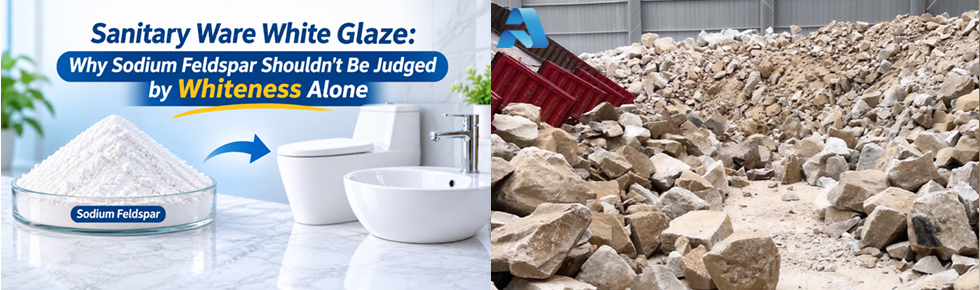
In sanitary ceramic manufacturing, white glaze is more than just an appearance feature. It also plays an important role in how customers perceive the quality of the finished product.
Whether it is a toilet, washbasin, or other bathroom ceramic product, a clean, uniform, and glossy white surface is an important quality requirement.
For this reason, many buyers pay close attention to the powder whiteness of Sodium Feldspar when selecting raw materials.
However, one point is worth considering:
Sodium Feldspar that looks white in powder form does not necessarily produce a whiter glaze after firing.
For sanitary ware white glaze, the key factors go beyond appearance. Chemical composition, impurity control, fluxing properties, and overall firing performance all deserve attention.
First, it is important to distinguish between two different properties: raw material powder whiteness and fired glaze whiteness.
Powder whiteness mainly reflects how the raw material reflects light before firing. Fired glaze whiteness, on the other hand, is influenced by the glass phase formed during high-temperature firing, impurity distribution, and the structure of the glaze layer.
Once Sodium Feldspar is added to a glaze formulation, it participates in high-temperature melting and contributes to glass-phase formation. Its original powder color alone cannot fully predict the final glaze appearance.
For example:
Some raw materials may have high powder whiteness but inconsistent chemical compositions, resulting in variations in firing performance.
Some powders may not appear exceptionally white, yet can produce good fired glaze whiteness when used in a suitable formulation.
If the raw material contains excessive coloring impurities, these may affect the final glaze color even when the powder looks relatively white.
Therefore, sanitary ware manufacturers should not judge Sodium Feldspar quality simply by looking at the powder.
Among the chemical components of Sodium Feldspar, Fe₂O₃ (iron oxide) is one of the key indicators to monitor.
Iron impurities may influence glaze coloration during firing, particularly in glaze systems where high whiteness and color purity are required.
If the iron content is too high, or fluctuates significantly between batches, it may lead to:
Yellowish, greyish, or other unwanted color tones in the fired glaze.
Greater color variation between production batches.
Reduced consistency in sanitary ware products requiring high whiteness.
Of course, the actual impact also depends on the glaze formulation, the iron content of other raw materials, and the firing atmosphere.
When selecting Sodium Feldspar, buyers should therefore look beyond whether the Fe₂O₃ content is low enough. They should also consider whether the supplier can maintain consistently controlled iron levels over time.
Low iron content matters, but consistently low iron content matters even more.
For Sodium Feldspar, Na₂O (sodium oxide) is another important chemical indicator.
Na₂O is an important fluxing oxide that participates in the high-temperature melting process. It influences liquid-phase formation, melt viscosity, and glaze maturation.
In sanitary ware white glaze formulations, an appropriate Na₂O content can help:
**Adjust the melting temperature of the glaze.
**Promote glass-phase formation.
**Improve glaze melting and leveling behavior.
**Achieve a smoother and more uniform glaze surface.
However, higher Na₂O content is not always better.
Excessive fluxing may reduce melt viscosity too much, causing excessive glaze flow and potentially affecting glaze stability.
This is why Sodium Feldspar should be evaluated through its overall chemical composition, including Na₂O, Al₂O₃, and SiO₂, rather than focusing on a single parameter.
For sanitary ceramic manufacturers operating continuous production lines, raw material consistency is often more valuable than an excellent test result from just one batch.
Imagine two suppliers providing Sodium Feldspar, with both samples meeting the required specifications in the initial evaluation.
However, their subsequent supply performance is different:
Supplier A maintains relatively stable Na₂O and Fe₂O₃ levels across different batches.
Supplier B experiences considerable fluctuations in chemical composition between deliveries.
Even if the initial samples perform similarly, their long-term production results may differ.
Variations in raw material composition can require repeated glaze formulation adjustments, increase production management difficulties, and potentially affect the color and surface quality of finished products.
This is why professional ceramic manufacturers should not rely on a single COA (Certificate of Analysis) when evaluating a Sodium Feldspar supplier.
It is equally important to understand the supplier’s raw material selection, production control, laboratory testing, and batch management processes.
For sanitary ware manufacturers, several key parameters should be evaluated together.
In addition, actual firing temperature, glaze thickness, firing atmosphere, and the final whiteness and gloss should all be considered during evaluation.
For sanitary ware white glaze, laboratory data is only the first step. Actual firing tests provide essential evidence of whether a raw material is suitable for the intended application.
At LSAK Feldspar, we believe that the value of quality Sodium Feldspar should not be judged by powder appearance alone.
For sanitary ceramics and other high-whiteness ceramic applications, chemical composition, low-iron control, Na₂O content, and batch-to-batch consistency all deserve close attention.
We focus on every stage of Sodium Feldspar production, from raw material selection and processing to finished product inspection, with the goal of supplying mineral materials that offer consistent quality and meet customers’ production requirements.
If you are looking for Sodium Feldspar for sanitary ware white glaze, feel free to contact us for product TDS and samples.
Practical formulation and firing tests are the best ways to evaluate whether a raw material truly matches your production process.
Final Thoughts
When selecting Sodium Feldspar for sanitary ware white glaze, don’t judge it only by how white it looks in the bag.
What really matters is whether it can help achieve the desired glaze performance after high-temperature firing and maintain consistent results throughout continuous production.
Good raw materials should deliver consistent results, not just good-looking powder.
📞Tel:+86 158 3720 7537 (WhatsApp)
📧Email: info@lsakminerals.com
🌐Web: www.lsakminerals.com

Whether you have questions or you would just like to say hello,Contact us!
Call Anytime:
+86 15837207537Send E-mail:
info@lsakminerals.comAddress:
Anyang City , Henan Province, China.