
In ceramic glaze formulations, both potassium feldspar and sodium feldspar are common fluxing materials. They introduce alkali metal oxides into the glaze, promoting the formation of a glass phase. However, they differ in melting behavior, melt viscosity, firing window, and glaze surface performance.
When selecting a feldspar, it is not enough to simply ask “which one has the lower melting point.” For ceramic manufacturers, the more critical questions are whether it matches the existing kiln conditions, the overall glaze system, and the target glaze surface effect.
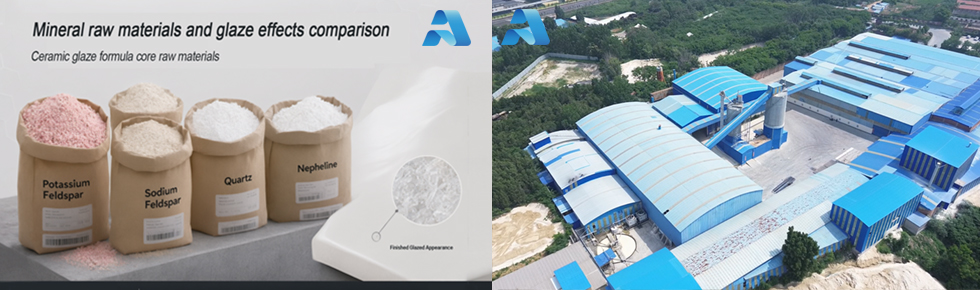
Sodium feldspar generally has a higher Na₂O content and stronger fluxing power. It helps the glaze form a liquid phase earlier, lowers the maturation temperature, and is suitable for systems that require low-temperature melting, fast-firing processes, or a high degree of vitrification.
However, sodium feldspar typically has a relatively narrow melting range, and melt viscosity drops more rapidly. Excessive use can increase the risk of glaze running, flowing, or uneven glaze layers.
Potassium feldspar usually has a higher melting temperature and a wider melting range. At high temperatures its melt viscosity remains relatively higher, which helps control glaze fluidity and firing stability. It is well suited to mid- to high-temperature glazes or production processes that require a broader firing window.
A glaze is not necessarily better simply because it melts faster. In actual production, glaze surface stability depends on melt viscosity, fluidity, firing temperature, soak time, and the cooling process.
Sodium feldspar promotes early liquid-phase formation and can improve the degree of vitrification. However, if the Na₂O proportion in the formula is too high, it may cause over-flow, glaze pooling, or changes in the thermal expansion coefficient, which in turn affect glaze fit.
In some formulations, potassium feldspar provides a relatively more “stable” melting behavior that helps control glaze layer thickness and tolerate firing fluctuations. This does not mean potassium feldspar is inherently more stable than sodium feldspar—the final result still depends on the overall glaze composition.
In appropriate formulations, sodium feldspar helps form a uniform glass phase and can positively influence gloss, transparency, and surface smoothness.
Potassium feldspar is also widely used in ceramic glazes and can be employed to adjust melting behavior and surface texture according to formulation needs. Gloss, transparency, and surface texture are never determined by potassium or sodium alone.
Quartz, alumina sources, calcium- and magnesium-bearing materials, the proportions of other fluxes, glaze layer thickness, firing schedule, and kiln atmosphere all influence the final result.
Potassium feldspar and sodium feldspar are not necessarily an either-or choice. Many glaze formulations adjust the K₂O-to-Na₂O ratio in order to balance:
**Glaze maturation temperature
**Width of the firing window
**High-temperature melt viscosity and fluidity
**Gloss, transparency, and surface texture
**Stability during the firing process
Potassium feldspar and sodium feldspar each have advantages and suitable application ranges. Potassium feldspar is not automatically better for high-temperature glazes, nor is sodium feldspar automatically suitable for every low-temperature glaze simply because of its strong fluxing power. The truly rational choice is to match the chemical composition, particle-size specifications, and batch-to-batch consistency of the feldspar with the glaze formulation, kiln conditions, and target glaze surface effect.
📞Tel:+86 158 3720 7537 (WhatsApp)
📧Email: info@lsakminerals.com
🌐Web: www.lsakminerals.com

Whether you have questions or you would just like to say hello,Contact us!
Call Anytime:
+86 15837207537Send E-mail:
info@lsakminerals.comAddress:
Anyang City , Henan Province, China.