
In industrial production sectors such as ceramics, glazes, and glass, nepheline raw material quality not only influences formula design but also determines the stability of the manufacturing process.
For enterprises purchasing Nepheline on a long-term basis, the primary concern extends beyond whether initial samples meet specifications; it is crucial to ensure that subsequent batches maintain consistent chemical composition and particle size.
Frequent fluctuations in raw material quality may force manufacturers to repeatedly adjust their formulas, increasing the workload for testing and trial firings. Therefore, batch consistency is a key factor to prioritize when selecting a Nepheline supplier.
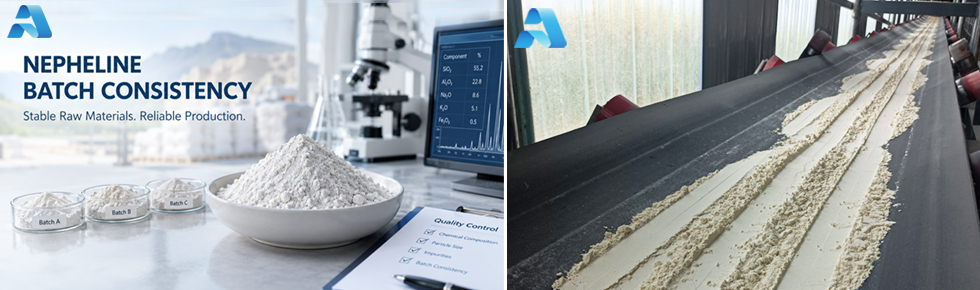
The chemical composition of Nepheline directly affects its performance in various formulations. For purchasers, key indicators to monitor include Na₂O, K₂O, Al₂O₃, SiO₂, and Fe₂O₃.
For instance, variations in alkali metal oxide content can alter the melting behavior of the material, while iron content is a critical metric for color-sensitive applications such as high-whiteness ceramics and light-colored glazes.
Significant compositional differences between batches—even if each batch technically meets basic specifications—can introduce unnecessary complexity to formula adjustments.
Consequently, customers require more than just a qualified Certificate of Analysis (COA); they need suppliers capable of delivering consistent quality within agreed-upon tolerances over time.
Beyond chemical composition, particle size is another vital consideration in Nepheline procurement.
Variations in fineness and particle size distribution can affect mixing uniformity, processing efficiency, and overall performance in specific formulations. If the proportion of coarse particles or overall fineness fluctuates significantly between batches, customers may need to re-evaluate their mixing or processing conditions.
Naturally, finer powder is not always better. The optimal particle size depends on the end-use application, production equipment, and specific formula requirements.
For long-term partnerships, defining clear particle size specifications and ensuring batch-to-batch consistency is far more valuable than simply pursuing the finest possible powder.
While a COA is a fundamental document for verifying Nepheline quality, it does not reflect all aspects of actual application performance.
A test report confirms whether a sample’s chemical composition meets requirements, but it cannot guarantee that bulk shipments will maintain the same standards. Suitability for a specific formula must be validated through actual production conditions.
1. Whether there are defined control ranges for major chemical components;
2. The stability of test results across different batches;
3. Whether the particle size meets actual production needs;
4. Whether the supplier follows standardized sampling and quality control procedures;
5. Whether sample test results can be consistently replicated in subsequent deliveries.
These insights help provide a more comprehensive evaluation of suppliers, rather than relying solely on a single sample submission.
For factories requiring continuous Nepheline usage, clearly defining quality requirements prior to procurement is essential.
First, determine key chemical indicators and particle size ranges based on your specific application. Requirements vary by use case, so actual formulas and production conditions should serve as the benchmark.
Second, conduct thorough sample testing. For ceramic and glaze applications, evaluate material performance in conjunction with your formula and firing conditions; other applications should employ their respective process testing methods.
Finally, do not overlook quality management for bulk supply. Beyond the initial sample, assess whether the supplier conducts continuous product testing and maintains quality records for different batches.
Adopting these practices helps reduce the uncertainty caused by raw material variations, making it easier for procurement and technical teams to judge product suitability for long-term use.
For industrial mineral purchasers, selecting a supplier involves more than just comparing prices; it requires evaluating product specifications, quality control, and long-term supply capabilities.
LSAK Feldspar specializes in the supply of industrial mineral raw materials, placing strong emphasis on raw material selection, production processing, and quality inspection. Regarding Nepheline procurement, we advise customers to define chemical composition, particle size, and other key requirements based on actual usage, and to validate product suitability through sample testing.
For customers with long-term procurement plans, discussing quality specifications and batch requirements in advance helps establish clearer supply standards.
Having a qualified sample is merely the starting point of procurement evaluation. For enterprises engaged in continuous production, raw materials that consistently meet agreed specifications are essential for maintaining stable manufacturing processes.
If you are looking for a Nepheline supplier, please feel free to contact LSAK Feldspar to discuss your requirements for chemical composition, particle size, and applications. We can explore suitable product specifications and initiate sample evaluations based on your specific needs.
📞Tel:+86 158 3720 7537 (WhatsApp)
📧Email: info@lsakminerals.com
🌐Web: www.lsakminerals.com

Whether you have questions or you would just like to say hello,Contact us!
Call Anytime:
+86 15837207537Send E-mail:
info@lsakminerals.comAddress:
Anyang City , Henan Province, China.