In ceramic, glaze, and glass manufacturing, iron may be present in relatively small amounts in raw materials, yet it can influence the color, whiteness, and optical properties of finished products.
For high-whiteness ceramics, light-colored glazes, and glass products sensitive to iron impurities, controlling the Fe₂O₃ content in nepheline is important. Maintaining consistency from batch to batch is equally essential.
The key is not simply how low the iron content is, but how consistently it can be controlled across different batches.
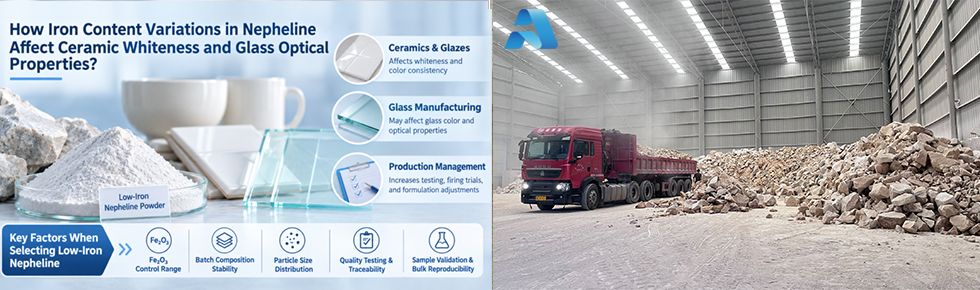
Nepheline is an alkali aluminosilicate mineral used in ceramic bodies, glazes, and selected glass formulations. Its chemical composition and fluxing properties make it a useful raw material for various industrial applications.
However, the Fe₂O₃ content of a raw material can influence the color of the final product.
In ceramic and glaze production, iron impurities may cause unwanted color variations in white or light-colored products, affecting fired whiteness and visual consistency. In glass manufacturing, iron content and its chemical state may also influence glass color and optical properties. The actual effects depend on the glass composition and processing conditions.
For applications with strict requirements for whiteness, color consistency, or optical performance, selecting nepheline with low and consistent iron content is particularly important.
Even when nepheline meets the specified Fe₂O₃ limit, variations in chemical composition between batches may create additional challenges during production.
Ceramics and Glazes: Whiteness and Color Consistency
In high-whiteness ceramics, sanitaryware, and light-colored glaze formulations, changes in raw material composition may affect the final fired color.
If significant variations occur between batches, manufacturers may need to reassess their formulations or adjust firing parameters to maintain consistent product appearance.
Glass Manufacturing: Color and Optical Performance
For glass formulations sensitive to iron impurities, changes in raw material iron content may affect glass color and related optical properties.
Consistent raw material chemistry helps reduce variations in batch composition. However, the final results must still be evaluated in relation to the glass formulation, melting conditions, and finished-product testing.
Production Management: Additional Testing and Adjustments
When raw material quality varies, technical teams may need to conduct additional sampling, laboratory testing, firing trials, or formulation adjustments.
For continuous manufacturing operations, raw material consistency is therefore important not only for product quality but also for production efficiency.
A COA (Certificate of Analysis) is an important document for evaluating nepheline raw materials. It provides information about key chemical components, including Fe₂O₃, Al₂O₃, Na₂O, and K₂O.
However, a single COA generally reflects the test results of a specific batch. It cannot, on its own, demonstrate that the supplier can maintain the same quality throughout long-term deliveries.
When evaluating a nepheline supplier, buyers should also consider the following factors:
✅Fe₂O₃ Control Range: Does the iron content meet the requirements of the intended formulation?
✅Batch-to-Batch Consistency: Are variations in chemical composition adequately controlled?
✅Particle Size Distribution: Does the particle size meet the requirements of the production process?
✅Quality Control Records: Does the supplier maintain systematic sampling, testing, and batch traceability records?
✅Application Testing: Can the results obtained from initial samples be reproduced during subsequent bulk production?
For manufacturers purchasing nepheline powder on a regular basis, these factors provide a more comprehensive basis for evaluation than comparing the test results of a single batch alone.
Low-iron nepheline does not mean that the same iron content specification is suitable for every application. Different ceramic, glaze, and glass formulations may have different requirements for chemical composition and impurity control.
For example, some high-quality nepheline products can achieve an Fe₂O₃ content below 0.05%. However, this figure should be verified against the actual test results of the specific product and should not be regarded as a universal specification for all nepheline materials.
When evaluating nepheline for industrial use, manufacturers should consider several factors:
✅The required whiteness, color, or optical performance of the finished product.
✅The acceptable Fe₂O₃ range and other key chemical specifications.
✅The compatibility of particle size with the existing production process.
✅Quality consistency across different batches.
✅Results from laboratory testing and actual production trials.
Evaluating these factors together helps manufacturers determine whether a particular nepheline product is suitable for their application and reduce unnecessary adjustments caused by raw material variations.
5. Consistent Raw Material Quality Is Essential for Long-Term Production
For ceramic and glass manufacturers, selecting nepheline should involve more than evaluating the results of an initial sample. The quality of subsequent batches is equally important.
Ongoing chemical analysis, particle size control, and batch records help demonstrate a supplier’s quality management capabilities. Testing the material in the customer’s own formulation can further confirm whether it meets specific production requirements.
Low iron content addresses impurity levels, while batch-to-batch consistency supports reliable production over time. Together, these factors provide a stronger foundation for consistent product quality.
If you are evaluating nepheline powder for your production process, consider the Fe₂O₃ control range, batch-to-batch chemical consistency, and particle size specifications. Reviewing the product’s TDS, batch test data, and application trial results can help you determine whether the material is suitable for long-term use.

Whether you have questions or you would just like to say hello,Contact us!
Call Anytime:
+86 15837207537Send E-mail:
info@lsakminerals.comAddress:
Anyang City , Henan Province, China.