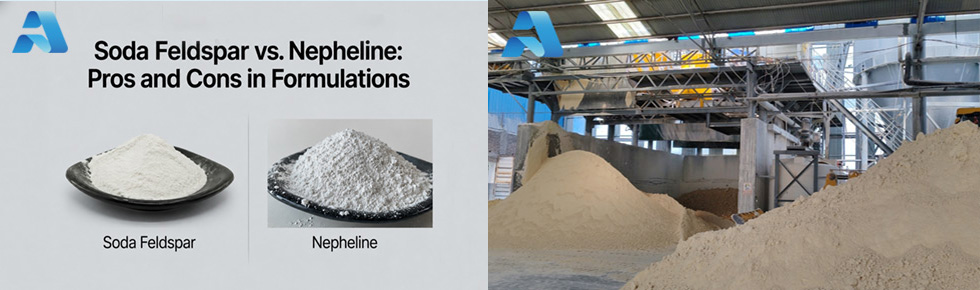
The chemical formula of nepheline can be simplified as Na₂O·Al₂O₃·2SiO₂. It has a relatively low silica content, but an extremely high content of alkali metals (sodium, potassium) and alumina.
Extremely Strong Fluxing Power: With alkali metal content reaching up to 20%, nepheline offers powerful fluxing effects. It can significantly lower the firing temperature of a formulation, shorten the firing cycle, and deliver outstanding energy-saving results.
Saves Formulation Space: Because it provides a large amount of both alkali metals and alumina simultaneously, it can greatly reduce or even replace chemical raw materials like soda ash and potassium carbonate in the formulation. This also frees up space to introduce other materials (such as quartz or kaolin).
Improves Glaze Defects: In top glaze formulations, increasing the proportion of nepheline can effectively reduce glaze defects like pinholes, resulting in a finer, smoother glaze surface.
High Risk of Crazing: Among alkali metals, sodium has the highest thermal expansion coefficient. If the dosage of nepheline in a formulation is too high, it can easily cause the glaze to craze due to a mismatch in the thermal expansion coefficient.
Raw Ore Impurity Issues: Natural nepheline syenite ore often has a high iron content. If used directly in ceramics or glass with high whiteness requirements without strict iron removal processing, it can cause the product to darken or develop spots.
Soda Feldspar: The Stable and Reliable “Classic”
The chemical formula of soda feldspar is Na₂O·Al₂O₃·6SiO₂. Its silica content is much higher than that of nepheline, while its alkali metal and alumina contents are relatively moderate.
Wider Firing Range: Compared to nepheline, soda feldspar has a broader melting temperature range, and its melt viscosity changes more gradually with temperature. This means it has a higher fault tolerance during firing, and the body is less likely to deform due to localized over-firing.
Enhances Translucency: At high temperatures, soda feldspar can effectively dissolve quartz and clay to form a uniform glassy phase, which helps improve the translucency and mechanical strength of the ceramic body.
More Stable Color Performance: In glazes, soda feldspar provides stable fluxing effects without easily triggering severe crazing issues like high-alkali formulations.
Relatively Lower Fluxing Efficiency: Because it contains a large amount of silica (about 68%), its unit fluxing efficiency is not as high as that of nepheline. To achieve the same melting effect, a larger dosage is usually required.
Lower High-Temperature Viscosity: Although its firing range is wider than that of nepheline, the high-temperature viscosity of the soda feldspar melt is still relatively low. If used in excessive amounts, it may lead to over-flowing of the glaze or running.
If your formulation goal is extreme low-temperature firing, rapid production, or replacing some expensive chemical raw materials, nepheline is an excellent “game-changer.” However, if your product has extremely high requirements for firing stability and deformation resistance, or if you need to control the risk of glaze crazing, soda feldspar is a safer and more fundamental “ballast.” In practical applications, blending the two in a reasonable ratio can often combine their strengths and achieve the optimal formulation results.
📞Tel:+86 158 3720 7537 (WhatsApp)
📧Email: info@lsakminerals.com
🌐Web: www.lsakminerals.com

Whether you have questions or you would just like to say hello,Contact us!
Call Anytime:
+86 15837207537Send E-mail:
info@lsakminerals.comAddress:
Anyang City , Henan Province, China.