Over the past couple of years, the glass fiber industry has expanded a lot, but many plants have been privately complaining about the same issue: once the raw materials start fluctuating, the entire production line suffers.
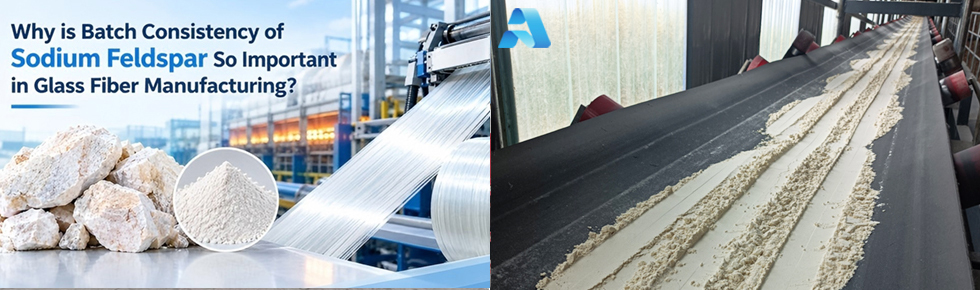
In glass fiber formulations, sodium feldspar is more than just a simple flux. The sodium oxide it brings lowers the melting temperature, saving energy and reducing the need for soda ash. At the same time, the alumina it contains helps build a stronger glass network, resulting in fibers with higher strength and better corrosion resistance. More importantly, it melts relatively slowly and has a low tendency to crystallize, so it is less likely to suddenly precipitate crystals during fiber drawing and break the filaments.
The real problem lies in the word “stable.”
Tank furnace drawing is a continuous process that runs around the clock. If the Na₂O content in the sodium feldspar jumps up and down from one batch to the next, the iron content fluctuates, or the particle size varies, the furnace temperature has to be adjusted constantly and the viscosity changes accordingly. The result is more broken filaments, increased fuzz, uneven fiber diameters, and in serious cases, entire batches failing to meet specifications. High-end electronic fabrics and yarns for wind turbine blades demand even tighter consistency — any instability in the raw material can lead to direct returns from downstream customers.
That is why glass fiber manufacturers no longer look only at price and average specifications when choosing sodium feldspar. They repeatedly ask: Can you guarantee that every batch is consistent? Can the mine supply long-term? Do you have stable testing and process control?
Experienced buyers in the industry know that the truly reliable suppliers are still those with their own mines and relatively strict processing controls. Only when the chemical composition fluctuates little, iron content is well controlled, and particle size stays consistent can the production line truly run smoothly.
Glass fiber is still moving toward higher-end applications. Wind power, automotive, and electronics all demand higher-performance yarns. If the raw material side cannot keep up, no amount of process adjustment later will fully make up for it. Stable-quality sodium feldspar has already shifted from a “nice-to-have” to a hard requirement for glass fiber plants.
📞Tel:+86 158 3720 7537 (WhatsApp)
📧Email: info@lsakminerals.com
🌐Web: www.lsakminerals.com

Whether you have questions or you would just like to say hello,Contact us!
Call Anytime:
+86 15837207537Send E-mail:
info@lsakminerals.comAddress:
Anyang City , Henan Province, China.