Albite Powder: What Really Determines Its Performance Isn’t Just Chemical Composition — It’s the Temperature in the Kiln
In the procurement stage of ceramic raw materials, buyers typically look at a few tables first: chemical composition, particle size distribution, whiteness, and the COA. These data points are certainly important — they’re the first threshold for screening suppliers.
But for ceramic production, the more critical question is really: once it enters the kiln, how exactly does it melt?
The same albite powder can produce entirely different final results across different firing temperature ranges. That’s why we don’t only provide paper parameters — we treat firing trials as part of the product documentation.
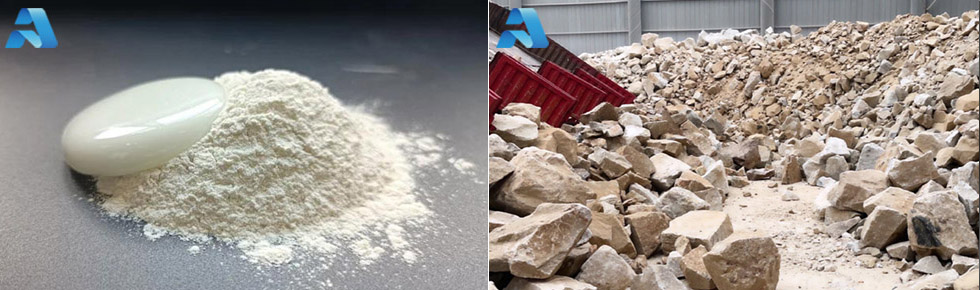
1130°C | Low-temperature firing — strong whiteness performance
Even at a relatively low firing temperature, the product maintains good whiteness. This indicates that the albite begins to exert its fluxing effect within a lower temperature range, helping the body reach an effective sintering state more quickly. For production lines pursuing low-temperature, fast-firing processes, this directly affects energy consumption and throughput rhythm.
1200°C | Full firing — noticeably improved translucency
As the temperature rises, the albite participates further in melting, liquid phase formation becomes more complete, and the body structure continues to densify, with the fired product showing more pronounced translucency.
The shift from “white” to “translucent” essentially reflects differences in the albite’s melting and vitrification capability at different temperatures — not simply a case of “higher temperature is always better.”
As temperature increases, albite gradually forms a liquid phase, promoting reactions and sintering between different mineral particles. This logic chain is continuous:
Temperature change → melting behavior change → liquid phase volume change → densification change → final product performance change.
So when selecting albite, beyond the COA, the questions worth pressing on are:
Can it melt stably at my specific firing temperature?
Can it effectively help reduce porosity and improve sintered density?
Is firing performance consistent across different batches?
The Core Message We Want to Convey
1130°C — white. 1200°C — translucent.
This comparison isn’t meant to showcase a single indicator. Rather, it’s meant to show that we focus on real firing performance and batch consistency, not just a set of static data.
For ceramic manufacturers, what’s being purchased isn’t a sheet of COA data — it’s a raw material that can reliably enter the production line. Only stable albite corresponds to stable fluxing performance and stable firing results.
If you’re looking for an albite powder suited to your own firing temperature and product system, feel free to contact us for detailed firing test data and product specifications.
📞Tel:+86 158 3720 7537 (WhatsApp)
📧Email: info@lsakminerals.com
🌐Web: www.lsakminerals.com

Whether you have questions or you would just like to say hello,Contact us!
Call Anytime:
+86 15837207537Send E-mail:
info@lsakminerals.comAddress:
Anyang City , Henan Province, China.