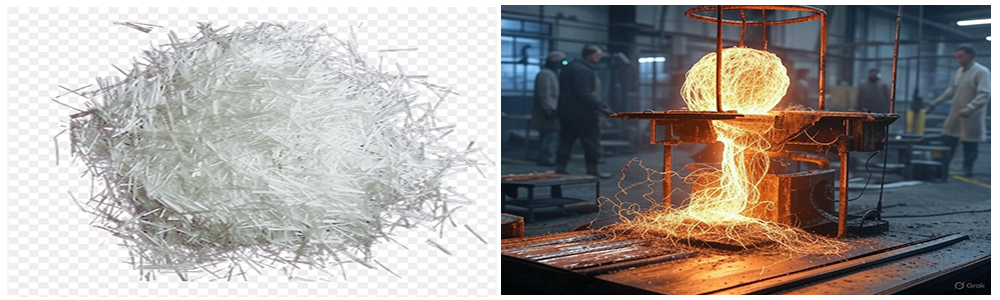
Glass fiber is an excellent inorganic non-metallic material, also known as Glass Fiber Reinforced Plastic (GFRP). Compared to carbon fiber and steel, it offers numerous advantages, including lightweight, high strength, thermal insulation, impact resistance, good flexibility, and affordability. According to MarketsandMarkets™, the glass fiber market is projected to grow from USD 27.14 billion in 2025 to USD 34.97 billion by 2030, with a compound annual growth rate (CAGR) of 5.2%. It comes in a wide variety of types.
The primary raw materials for glass fiber production include quartz sand (providing SiO₂), pyrophyllite (mainly providing Al₂O₃ and some SiO₂), limestone, dolomite, boric acid, soda ash, etc. Among these, pyrophyllite is the traditional mainstream source of alumina, especially in E-glass (alkali-free) fibers, where it can account for over 50%, delivering an optimal alumina-silica ratio (Al₂O₃ 18%–22%) that enhances fiber strength and reduces costs.
When incorporating a competitor’s sodium feldspar (NaAlSi₃O₈, primarily composed of Na₂O, Al₂O₃, and SiO₂) as a source of alumina (along with some sodium and silica), it offers the following standout advantages over traditional pyrophyllite and other raw materials:
By Product Type :Glass wool / Direct and assembled rovings / Chopped strand mat / Yarn / Woven roving Direct and assembled rovings currently dominate due to strong demand in composite manufacturing (especially wind turbine blades, marine components, and automotive parts).
By Resin Type :Polyester resin / Epoxy resin / Vinyl ester resin / Polyurethane resin Polyester and epoxy resins lead the market thanks to their superior adhesion, heat resistance, and structural reliability.
By End-Use Industry :Construction / Transportation / Wind energy / Electrical & electronics / Marine / Pipe & tank / Aerospace & defense / Consumer goods Construction holds the largest market share, followed by transportation and wind energy, with these sectors expected to grow rapidly over the next five years.
Regional Overview
North America: Remains the leading region due to robust demand from aerospace, defense, construction, and energy sectors. Advances in high-strength composites and government support for renewables are accelerating growth.
Europe: Driven by strict sustainability regulations, a dominant wind power market, and ongoing automotive lightweighting needs. Germany, France, Denmark, and the UK are key contributors.
Asia-Pacific: The fastest-growing market, fueled by rapid industrialization, wind energy investments, and large construction/manufacturing bases in China, India, South Korea, and Japan.
Latin America and Middle East & Africa: Emerging wind projects, marine infrastructure, and oil & gas expansion are creating new opportunities.
Leading manufacturers are investing in sustainable production, advanced reinforcement technologies, and recycling systems to meet global environmental goals.
Future Outlook Overall, incorporating sodium feldspar optimizes glass fiber production processes and product quality, delivering significant competitive advantages—especially amid rising energy costs and stringent environmental requirements. Looking ahead, as demand for high-performance glass fibers grows (e.g., in wind energy, electric vehicles, and 5G electronics), the use of sodium feldspar is steadily increasing (from 12% to 18% globally in E-glass). If your company supplies sodium feldspar, this represents a powerful point of differentiation!
📞 Tel: +86 158 3720 7537(WhatsApp)
📧 Email: info@lsakminerals.com
🌐 Web: www.lsakminerals.com

Whether you have questions or you would just like to say hello,Contact us!
Call Anytime:
+86 15837207537Send E-mail:
info@lsakminerals.comAddress:
Anyang City , Henan Province, China.